Silmer · AI CRM with human decisions
I redesigned how orders from WhatsApp become the production sheet the factory uses. The CRM captures production details in conversation and leaves commercial confirmation with sales.
Orders arrive in pieces and the factory needs a complete sheet
Silmer sells on WhatsApp and the factory works from a spreadsheet. Fabric, sizes and artwork can arrive in separate messages. The CRM had to retain what customers had already shared and let sales fill in the rest, with decisions about price, lead time and discounts left to people.
I replaced the Kanban with an order that accepts details out of sequence
The first version used columns and required fields for each stage. I revised it because a WhatsApp customer can send artwork, color and quantity at different points in the conversation. The order model had to keep up with that rhythm.
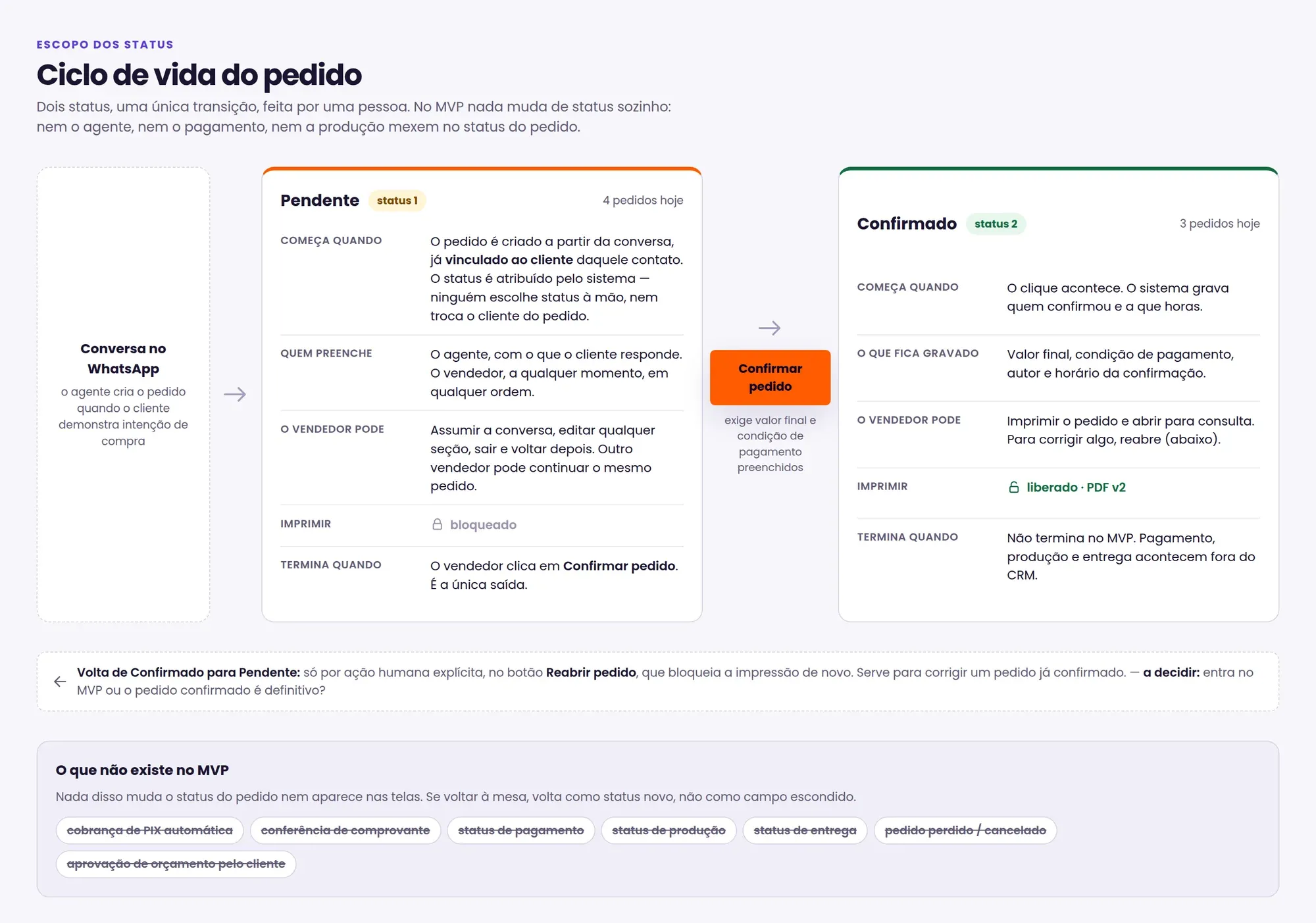
I defined Pending for a draft and Confirmed for the point at which a salesperson reviews the commercial details and commits to the order. The diagram documents that design decision. The timeline identifies which revisions were released.
Operations fit on a phone.
The visual foundation prioritizes the phone, with bottom navigation, touch targets of at least 44 px, and a separation between brand and states. The decision to generate and share the sheet as a PDF serves a document that has to leave the screen and circulate through operations.
What the choice requires. Two states represent fewer commercial stages in the interface. The sales rep reviews the data and decides when to confirm.
The production sheet guides what the CRM asks
I used the factory spreadsheet to work out which details needed to carry through from the conversation. I reduced the initial intake from 14 fields to seven points and later organized the questions by product type.
Sales replies exposed repeated gaps in artwork and fabric details. I brought those details back into the intake and kept the ability to use information customers had already provided in any order.
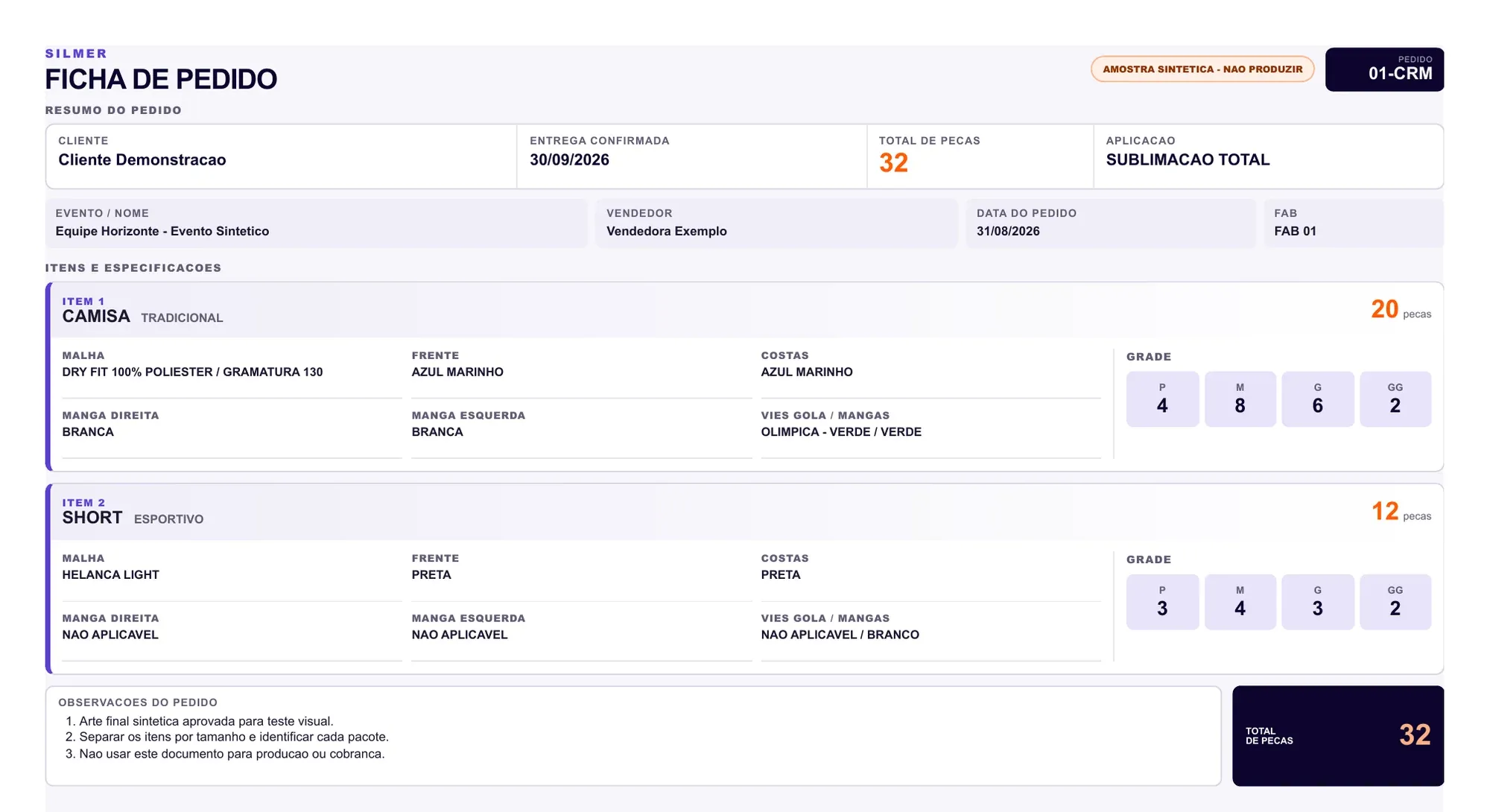
What the choice requires. A shorter collection leaves details for the sales rep. The criterion is reaching the handoff with useful context.
From chat to order form
Interactive demo. An illustration of the initial flow with fictional data: each customer reply lights up the form field it filled in. The price handoff and automatic order creation shown here were revisited in the decisions described in this case.
Jardim Aurora Association
WhatsApp · fictional conversation
With Paula
- The conversation starts when the customer writes.
Hi! I'd like a quote for T-shirts for our neighborhood race.
Order sheet: purpose.
Hi! I'm Silmer's assistant and I'll organize your T-shirt order for the team. What's your name?
Sure! It's the Jardim Aurora Association. The event is the Jardim Aurora Run 2026.
Order sheet: customer, order / event. Order 07-CRM created as pending.
Got it. What shirt style do you have in mind?
Dry-fit T-shirt, crew neck. About 80.
Order sheet: garment and style, fabric, quantity.
What color do you want for the shirts?
All white. S 15, M 30, L 25 and XL 10.
Order sheet: colors by part, size run, quantity.
That makes 80 pieces. Where does the print go?
I have the logo. It goes on the chest, with the sponsors on the back.
Order sheet: artwork, placement.
When do you need them?
By Nov 14. Can you deliver here in Vila Velha?
Order sheet: requested date, delivery.
I noted Nov 14 as the requested date. The team confirms the deadline after checking production. What's the delivery address?
I'll send it in a moment. And how much is it? Is there a discount if we order all 80?
Our team handles price and discounts. I've noted everything and called in a sales rep. She'll take it from here.
Handoff to a personThe agent stopped: the customer asked about price. The conversation went to a sales rep, with the order sheet and a summary.
Hi! This is Paula from Silmer. I already have your order sheet: 80 white dry-fit shirts, logo on the chest. Send me the address and I'll get you a quote.
Order sheet
07-CRMPendingcreated by the agent; only a person confirmsNo order yet: the agent creates it when the customer confirms the quote.
12 of 14 fields came from the conversation
Order summary
- CustomerAI · msg 3
- Jardim Aurora Association
- Order / eventAI · msg 3
- Jardim Aurora Run 2026
- PurposeAI · msg 1
- Event: neighborhood race
Item 1
- Garment and styleAI · msg 5
- T-shirt, crew neck
- FabricAI · msg 5
- Dry fit
- Colors by partAI · msg 7
- White on front, back and sleeves
- Size runAI · msg 7
- S 15 · M 30 · L 25 · XL 10
- QuantityRule · msg 7
- 80: the size run adds up
- ArtworkAI · msg 9
- Logo ready; sponsors to be laid out
- PlacementAI · msg 9
- Chest and back
- Technique—
- Missing: the sales rep decides
Logistics
- Requested dateAI · msg 11
- Nov 14 (the team sets the deadline)
- DeliveryAI · msg 11
- Delivery in Vila Velha/ES
- Address—
- Missing: customer will send
Closing · person only
- Price and termsPerson
- With Paula
Handoff to a person
Reason: asked about priceSummary written by the AI
Jardim Aurora Run 2026: 80 white dry-fit T-shirts, crew neck (S 15 · M 30 · L 25 · XL 10). Logo on the chest, sponsors on the back. Wants them by Nov 14, delivered in Vila Velha/ES. Asked about price and discount.
Missing: print technique and delivery address.
From here on the agent does not reply in this conversation. Price, discount, deadline and order confirmation belong to the sales rep.
Initial flow with a fictional customer, conversation, order and sales rep. ADR 051 revised the first-price-question handoff; ADR 056 reserved order creation for a person. This demo preserves the earlier version to illustrate the relationship between chat and brief.
AI collects. A person creates and confirms the order.
The model proposes data within a closed list; the API rejects fields outside the contract and code checks completeness. Discounts and negotiation always stay human.
The November 3 revision also reserved order creation for a person (ADR 056): asking for a price or completing the brief no longer creates an order automatically. The demo above shows the flow before that decision.
What the choice requires. The human gate adds an operational decision. In return, the agent’s collection prepares the order and commercial confirmation stays separate.
At the first price question, collection continues.
The first price question originally triggered a handoff. The October 29 review of nine conversations found three price handoffs in the first or second message, before any brief point was filled.
The published rule explains that sales provides the price and asks the next question. A second price question triggers a handoff, or a complete brief ends collection. The bot never gives prices, and once a person takes over it does not resume.
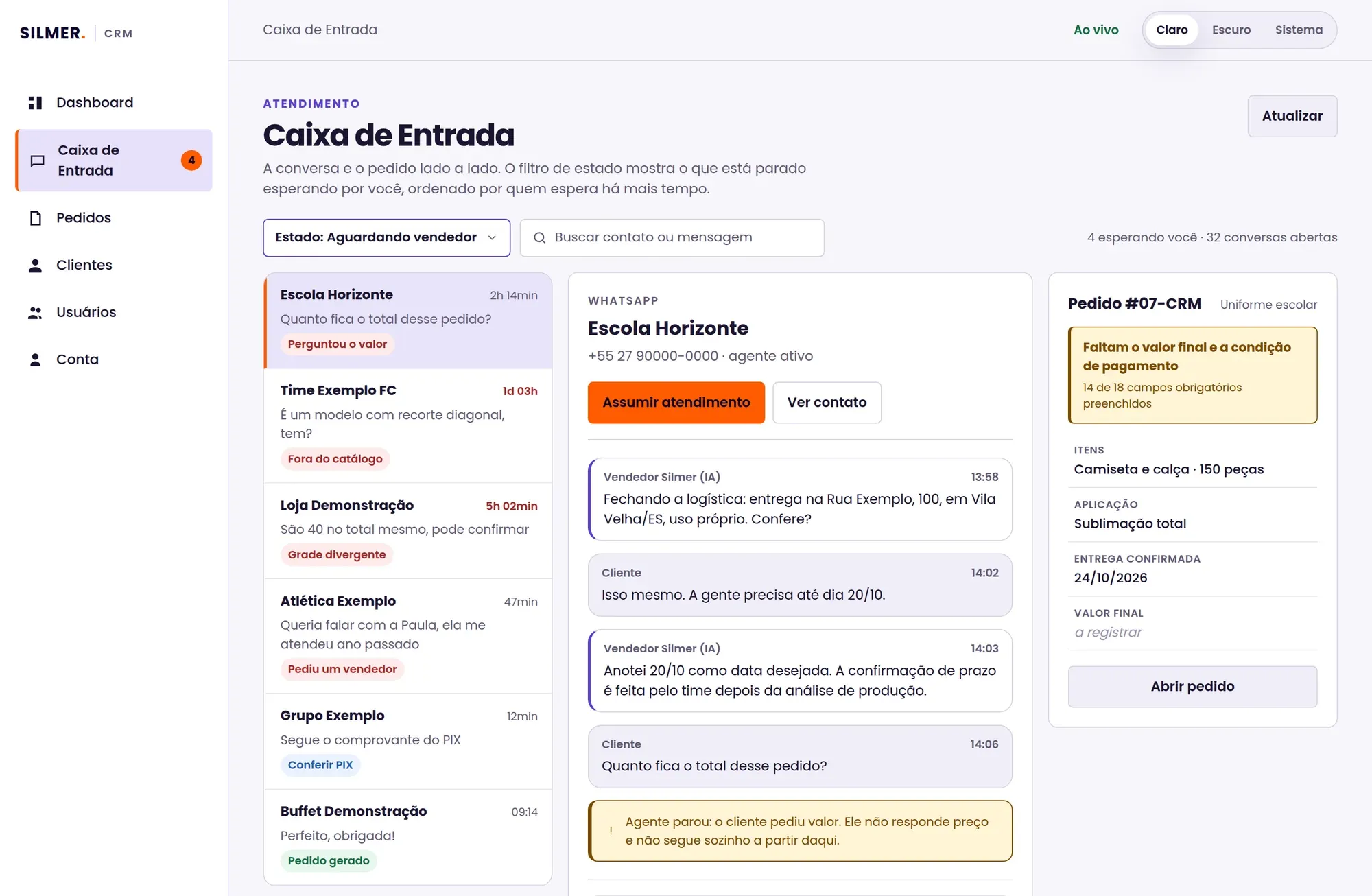
What the choice requires. Deferring once preserves the opportunity to collect context, but may extend the wait for a price.
The salesperson who says less.
Collection did not end with the bot: sales reps still recovered missing data and answered commercial questions. Reviewing conversations showed where to revise questions, messages and handoffs. The goal became handing the conversation to sales with enough context.
Remove a confirmation that did not change intent
ADR 010 · ADR 056 · Decision recorded
- Before
- “May I put together a quote request?”
- After
- Move to the next brief point without asking permission to collect missing information.
Why. I recorded the decision as PO, with the rejected alternative: asking just once would still add a message. The later human order-creation gate keeps the question out.
Explain who continues and where
ADR 010 · November 3 review · Notice documented; correction prepared
- Before
- “I’m calling someone now.”
- After
- “Of course! One of our sales reps will continue helping you right here.”
Why. The notice makes continuity in the same channel explicit, without promising immediate service. The November 3 review found that promise in an urgency notice and prepared a correction.
Receive an image and keep collecting
RFC 040 · ADR 051 · Published October 29; refinement prepared
- Before
- “I couldn’t open the image”, followed by a low-confidence handoff.
- After
- “I received your image and left it here for the sales rep to see.” Collection continues.
Why. The bot records the attachment for sales without inferring its content. The November 3 review prepared a question confirming whether the image is the artwork to print.
Reply to the group of messages
ADR 051 · Published October 29
- Before
- Two successive customer messages could generate two bot replies.
- After
- Wait eight seconds and reply to the group, checking whether a newer message arrived.
Why. Grouping avoids redundant and out-of-context replies, at the cost of about eight extra seconds per reply.
Bring the tone closer to sales responses
ADR 012 · ADR 051 · ADR 052 · Refinement prepared; publication to be confirmed
- Before
- “Great question!” before the price notice.
- After
- Explain that sales reps provide prices, without automatic praise.
Why. The human Direct messages reviewed were short and used almost no emoji. A no-praise rule already existed; removing this specific phrase is part of the next version.
What changed
The design gives sales a draft to complete before making a commercial commitment. Two revisions were confirmed as released. The seven-day dashboard describes conversation volume and handoffs for that window. The available figures leave conversion, order completeness and cost savings open.
- 14 → 7
fields in the initial collection, revised to seven points before a product-led sequence
Evidence: Deliverable - 2 states
Pending and Confirmed in the order cycle; confirming requires a person’s action
Evidence: System rule - 2 releases
of support adjustments, on October 28 and 29, 2026, informed by sales responses
Evidence: Deliverable - 35 conversations
183 bot replies and 29 handoffs on the seven-day dashboard viewed on November 3, 2026
Evidence: Measured
Sources and limits
Decisions recorded in ADRs and RFCs, with anonymized operational reviews. The seven-day dashboard viewed on November 3, 2026 recorded 35 conversations, 183 bot replies (a rounded average of 5.2 per conversation) and 29 handoffs (≈83%).
The dashboard is a descriptive snapshot. It has no turns broken down by version and no brief-completeness sample, and the Inbox review is limited to loaded conversations. It therefore does not compare versions or establish gains in conversion, time, satisfaction or cost. Handoff is part of the intended service: the proportion alone indicates neither success nor failure. The projection of 150 conversations per month used in the material is an assumption about volume.
There are five review records between October 28 and November 6; two are confirmed adjustment releases. The others include contracts, implementation or prepared corrections, and do not support claiming a daily routine. Adjusting prompts and workflow rules does not mean training model weights.
A shorter collection, grouped replies, a tone closer to sales, the PDF and the mobile-first foundation are design criteria: there is no published measurement of conversation quality, satisfaction, brand perception, adoption or reduced rework. Fewer messages alone do not establish a better conversation.
The initial research personas are synthetic; later reviews analyze real interactions. Screens and the demo use fictional data and represent an earlier version, before the price-handoff revision and the human order-creation gate.
Real client, with permission. Operational learning is summarized without customer names, contact details, transcripts or invoices. Records distinguish product ownership, technical contracts and commercial approval; they do not document people management.
How to read the level of evidence
- Evidence: Measured
- I measured it, and the case states the method.
- Evidence: System rule
- A guarantee of the project, checkable in the code or in the documented decision.
- Evidence: Deliverable
- Something that exists and was delivered. It describes the work, not an outcome.
What this work demonstrates
Revisiting my own model
Leadership is visible in revisiting the model and the limits of automation: removing the Kanban, shortening collection, revising the price trigger and reserving order creation for a person.
Learning from the people who sell
Sales responses in the Inbox revealed gaps in artwork, fabric and handoffs. Those findings became copy and rule revisions, with each round recorded as prepared or published.
The next success criterion
Check whether sales receives enough context and whether the customer reaches a person when needed. Comparing versions means measuring brief completeness, repeated questions, waiting and outcomes, alongside message count and cost.
Appendix: process, review records and cost
Process
- Start from operations
- I mapped the production sheet and connected its data to the WhatsApp journey. The order model needed to accept how selling actually unfolds.
- Define responsibilities
- I revisited the Kanban and order states. I separated what AI collects from what requires a human decision.
- Review with evidence of use
- Sales responses in the Inbox revealed gaps in artwork, fabric and handoffs. These findings informed copy and rule revisions.
- Separate decisions from publication
- Review records distinguish behavior, adjustment and status. Publication requires a backup and a way to revert; a prepared version counts as published only once it reaches production.
Conversation review records
Summary of decisions and reviews recorded through November 9, 2026. The examples in “The salesperson who says less” are system messages documented in the project.
- Oct 28 · Published
- Five conversations informed the feasibility response and the out-of-hours notice.
- Oct 29 · Published
- Nine conversations and sales responses informed artwork, fabric, pricing and message grouping.
- Oct 30 · Partial; workflow awaiting publication
- Contract for context and per-turn measurement; corrections to unintended handoffs.
- Nov 3 · Prepared; publication separate
- Inbox and dashboard review; five question and notice corrections prepared.
- Nov 6 · Prepared; publication separate
- Triage of commercial questions, urgency before brief completion and questions without repetition.
Cost as a decision model
The cost model considers model usage, any channel charges, sales time and maintenance time. A shorter conversation is only beneficial if it preserves adequate context and routing.
- Model choice
- Token pricing affects the bill, but no quality comparison between models is recorded. The case does not attribute savings to choosing an LLM.
- Copy and rules
- A longer prompt can consume more input while guiding fewer replies. Characters are not billed tokens; measurement needs to separate input, cached input and output.
- Channel and human operations
- Grouping replies can change message counts. The financial effect depends on the channel contract and delivery method; handoff time and maintenance also belong in the calculation.
- Assumptions, not savings
- The material simulates 150 monthly conversations, ten replies per conversation without the method and 6.5 after adjustments. The latter two values are assumptions, not measured versions. The observed average of 5.2 is a different kind of evidence and does not establish a reduction from ten to 5.2. A routine of 22 monthly 20-minute reviews at R$25 per hour would cost R$183.33 in maintenance alone: also an assumption, not observed spending. Model prices, WhatsApp charges and estimated savings are not published as financial outcomes.
How to move from hypothesis to measurement
- Reconcile model and channel usage and invoices; separate this service from other automations.
- Record prompt version and input, cached-input and output tokens for every turn, verifying collection coverage.
- Link each review to the sales finding, the decision owner and the version actually published.
- Compare periods and versions using equivalent criteria: handoff context, repetition, waiting, human time and outcomes; then calculate total cost.
Updated .
Hiring a Senior Product Designer or DesignOps Lead?
I am available immediately, 100% remote. Let's talk about how I can help your product.