Projeto Ressonância · cooperative card RPG for two players
A cooperative card RPG for Android. I redesigned the first turn so players could pick a card and target and understand the result on the battlefield.
The dialog interrupted the flow of combat
The player picked a card and a target, then saw the result in a dialog over the arena. I moved the effect to the target and kept the history available for players who wanted to review the details.
Players can follow the turn on the battlefield
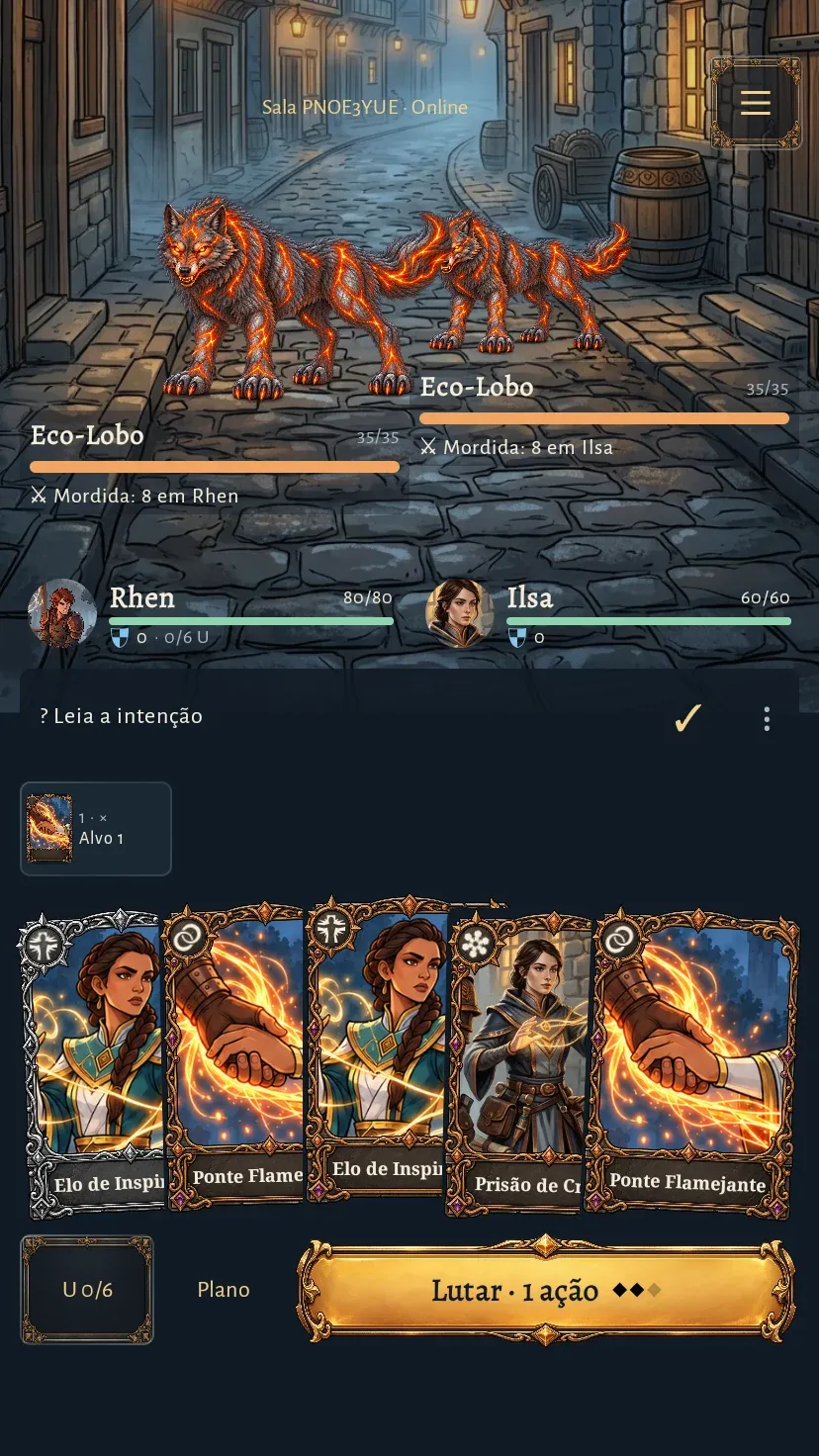
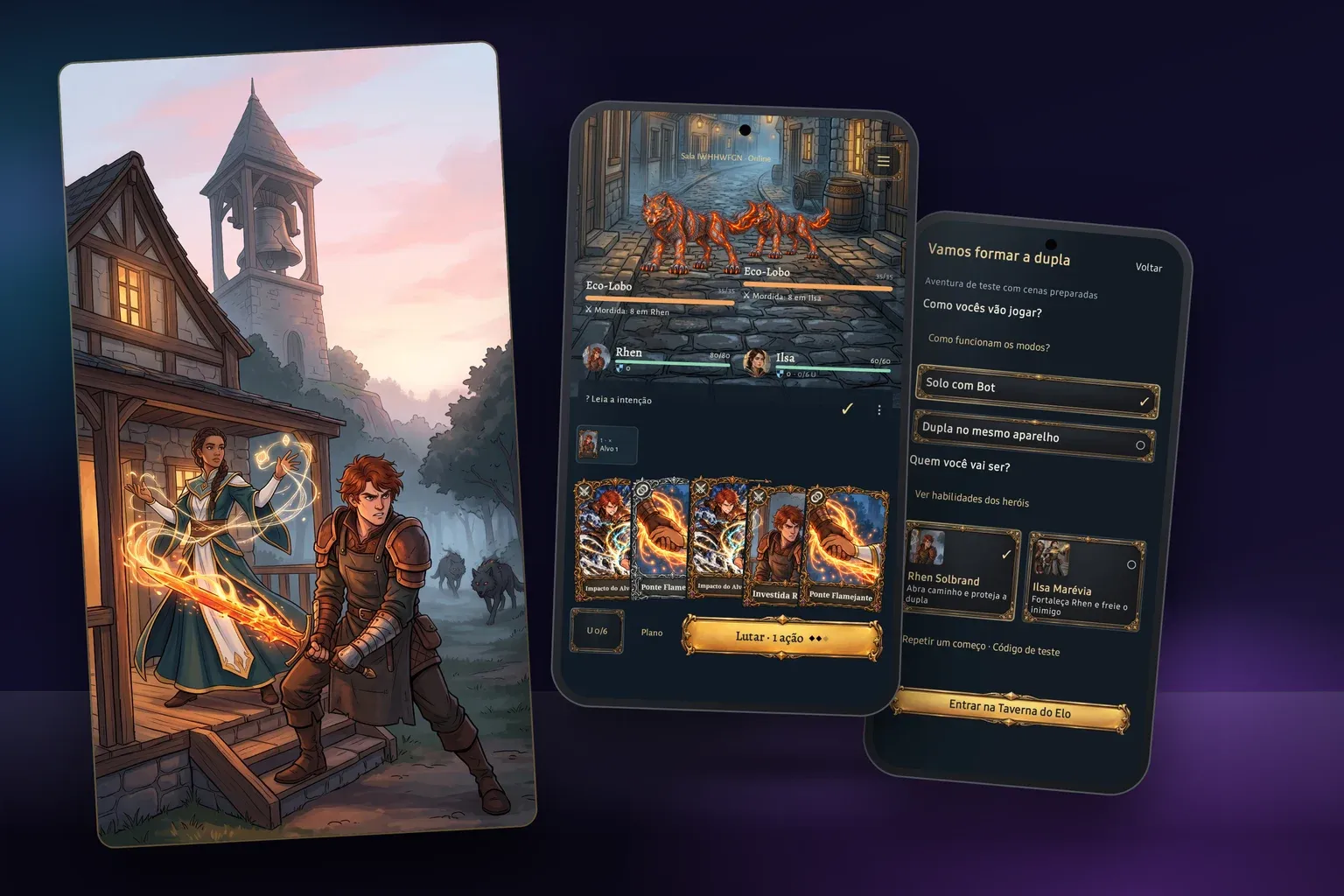
The first version showed the result in a dialog over the arena. I moved resolution into the scene so players could connect the card they chose to its target and effect. The history stayed available for reviewing details afterward.
In the recording, the player assigns a Solar Cut to each Echo Wolf and confirms the turn. The actions resolve on the battlefield. One enemy is defeated and the other has 11 of its 35 health points remaining.
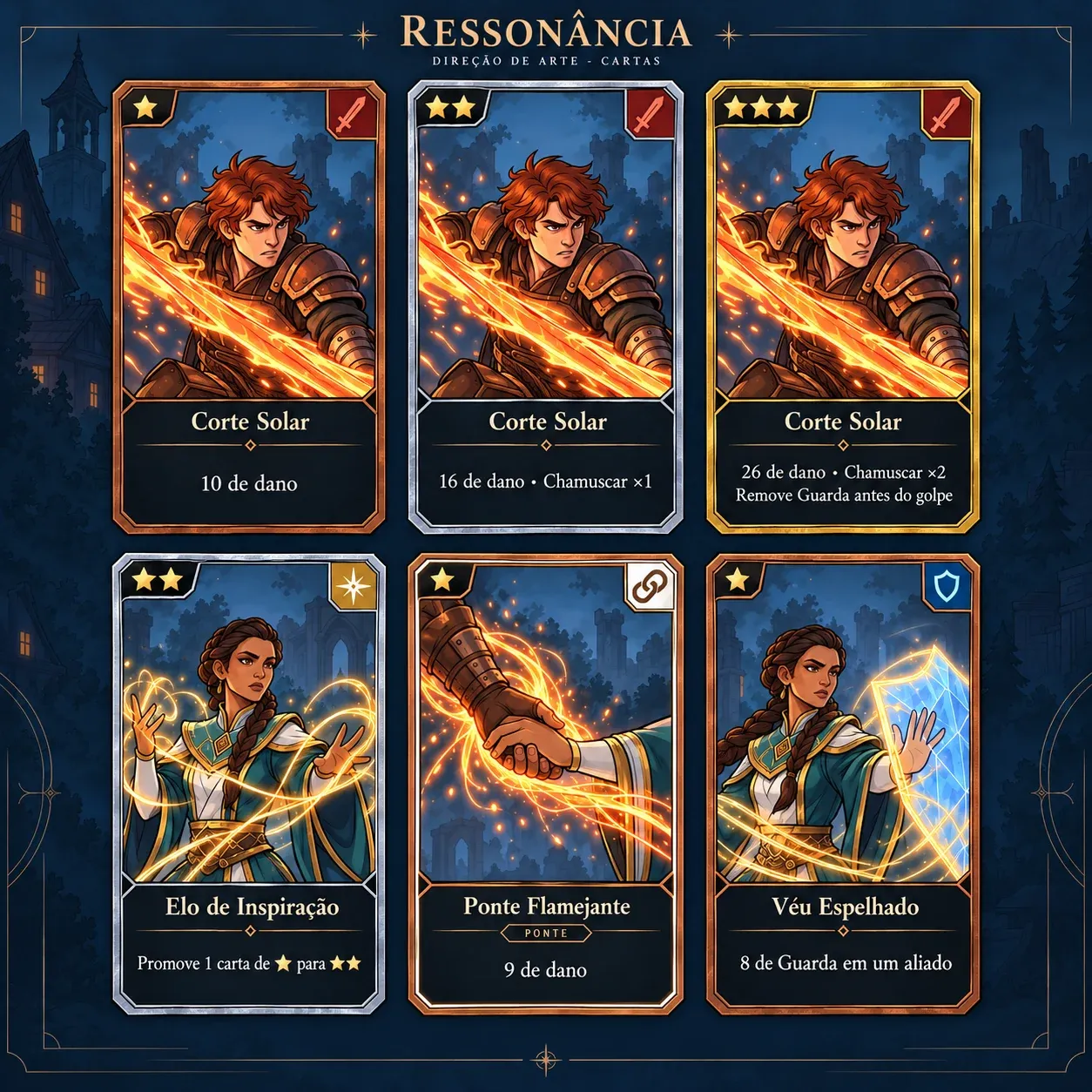
Rank, role and selection never get mixed up on the card.
Rank is the metal of the frame (bronze, silver or gold); role is a medallion with the attack, defense or support icon; selection is a light outline, independent of rank. There is no attack or Health number on the face, because techniques change effect with rank, and the preview comes from the engine. Name and effect are real text.
I compared large cards with a fanned hand and chose the fan, and I chose full-bleed art among three treatments.
Touch and text that hold up at 320 dp and a 130% font.
Every version runs the interface at 320, 360 and 414 dp, and the critical screens with the font at 130%. That found real problems: at 320 dp the center of a card's touch area could sit under its neighbor, so the areas now follow the exposed strip of the fan; on short screens the enemy lost its height; with an enlarged font, the last letter of the rank was cut off.
Main buttons are 60 dp, secondary ones 56 dp, and no information depends on color alone.
Tips the player asks for
The first-match tips started as dialogs and became a sentence on the screen itself, with ✓ to mark as read and ⋮ to dismiss; tapping the title reveals the explanation, and no window opens on its own during combat. The text follows the decision on screen: a question or a short verb, with the full rule on the card or in help.
Bots guide the numbers, and a hypothesis that does not hold up stays out.
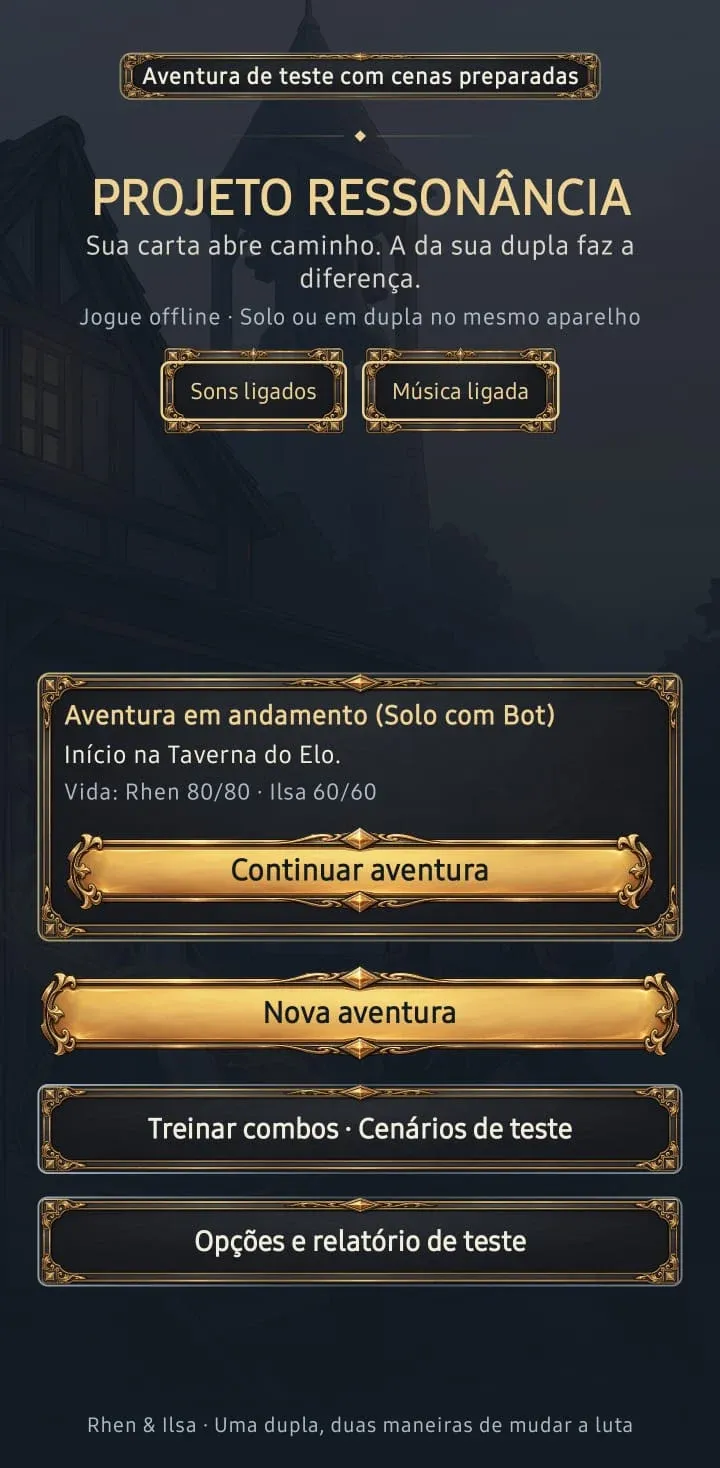
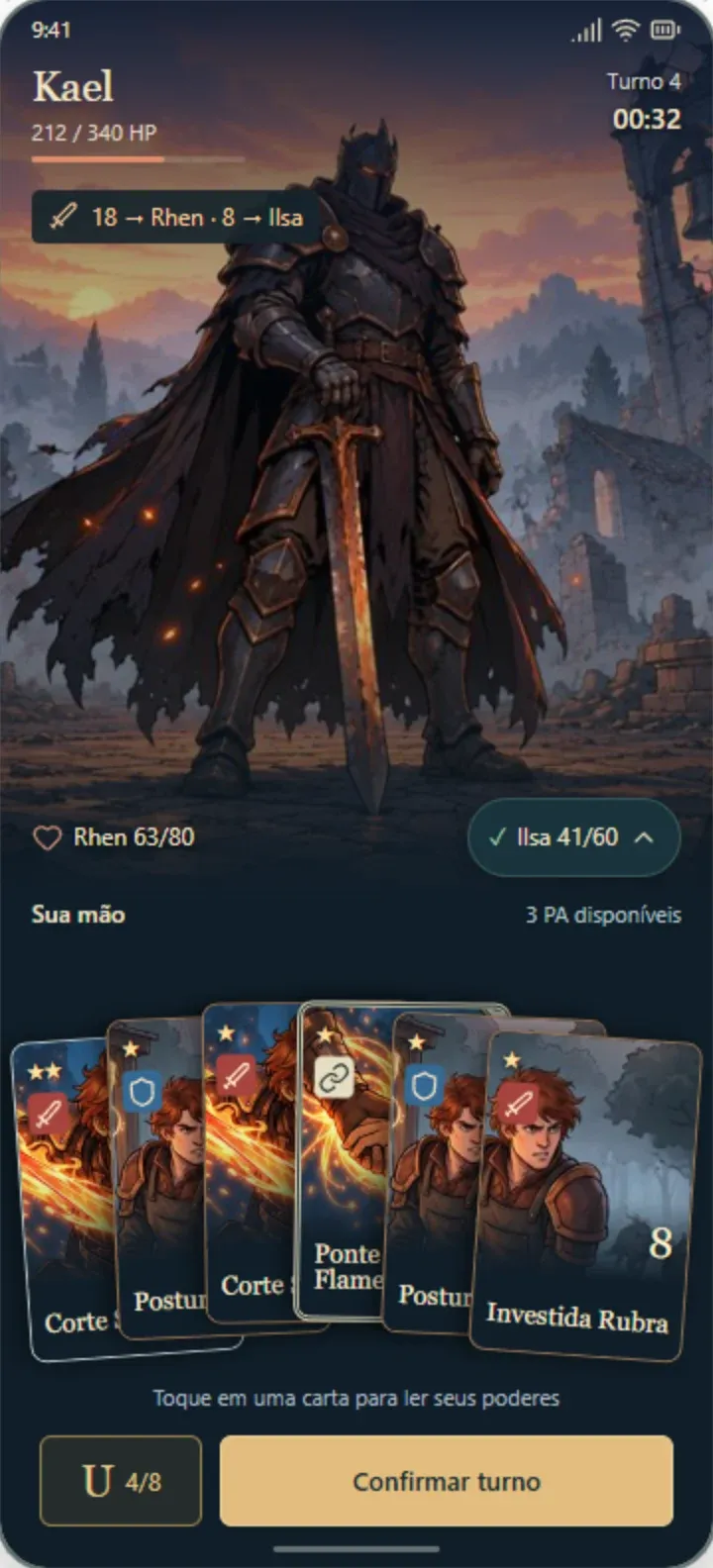
A session report exported from the app showed a win against the boss Kael in just a few turns, with no Resonance. In adventures simulated with bots, on held-out samples, I raised the boss's Health and the median number of turns went up. Later, lowering only the boss's Health made Resonance drop, so the meter's pacing had to change too.
For the automatic partner, the following versions reduced invalid promotions on fixed samples. The last study tested several hypotheses for the cases that remained; one brought invalid promotions to zero, but took valid promotions away in the same turns. None was shipped, and the record says so.
The reviews set what to build first.
Reviews produced with AI, in roles (optimist, pessimist, product and judge), assessed the initial concept. The judge recommended prototyping the core and not building the package with per-turn AI images or synchronous-only co-op, and gave low confidence in the initial concept as it stood: mandatory synchronous co-op was the biggest structural risk, and AI deciding the mechanics would be fatal.
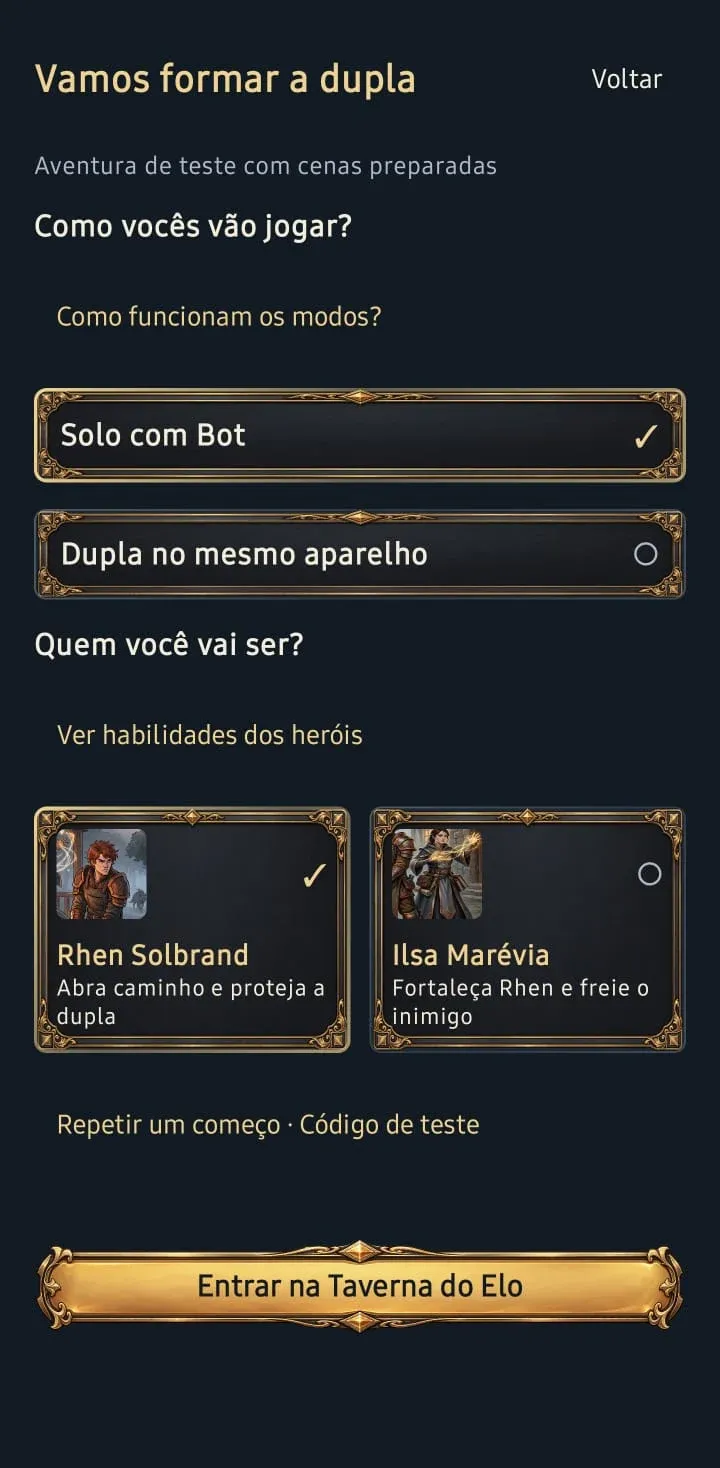
Today's app follows that line: solo with a bot and a pair on one device, an engine separate from any AI, and the remote pair only later.
What changed
The recording and emulator checks show how the turn works and where the controls needed changes. The next step is to watch new players choose a target, explain the card’s effect and move on to the next turn on a physical device.
- 320 dp
narrowest width tested, also with the font at 130%, on the Android emulator (and at 360 and 414 dp)
Evidence: Measured - Card → target → Fight
by tap or drag, in place of panels and a text resolution
Evidence: Deliverable - Fanned hand
chosen between large cards and overlapping ones, before any code
Evidence: Deliverable - Beyond color
rank by metal, role by symbol and selection by outline, independent of each other on the card; no information depends on color alone
Evidence: System rule - Not tested
a match between two people on physical phones; the current version is still waiting for that test
Evidence: Reported
Sources and limits
Engine, app and server tests run with each version; the interface runs on an Android emulator, at 320, 360 and 414 dp and with the font at 130% on the critical screens. The boss numbers come from bot studies: the boss pacing was chosen on an exploration sample and checked on a held-out one declared before the run.
Placeholder illustrations generated with AI; icons by Lorc / Game-icons.net (CC BY 3.0) and freely licensed tracks by composers, with credits in the app. The Portuguese-language master uses a locally generated voice.
No match between two people on physical phones has been evaluated, nor comprehension by new players. Fun, listening, FPS, battery use and a screen reader test are not in the records either.
There is no connected AI: it is a test APK, not published in any store, with prepared scenes labelled as such; the connected AI master is future work.
The bots are deterministic policies, not independent players, and the simulation measures neither fun nor comprehension. The boss and card numbers are the design-document baseline, with no validated balance.
The reviews were produced with AI, not by players.
The next step is to play with a second person, each on their own phone, watching the first fusion, the first Bridge and how the partner's plan is read, and to change numbers only after that. Then test with a screen reader, and only then think about hosting the server.
How to read the level of evidence
- Evidence: Measured
- I measured it, and the case states the method.
- Evidence: System rule
- A guarantee of the project, checkable in the code or in the documented decision.
- Evidence: Deliverable
- Something that exists and was delivered. It describes the work, not an outcome.
- Evidence: Reported
- Stated by me or by stakeholders, with no published data.
Appendix: details and process
Decision details
- Reading pauses
- Drawing, discarding and other administrative records stopped being reading pauses.
- Drag fixes
- In one of the early versions, the sequence from one of my screenshots was reproduced on the emulator: dragging to action 2 with two enemies, the card seemed to go back to the hand without saying the next step. It now stays in the action with “Choose the target”. And M, which looked like the actions, became “Free move”, with its own color and the note “Before actions”.
- Line height
- On short screens, the enemy lost its height because small text inherited a line height larger than the font.
- Thumbnails and finish
- Small thumbnails lose their ornaments and, below 34 dp, their text. When one version over-simplified the frame, I brought back the painted finish and the role icon in the medallion.
- Tips in a pair, and vocabulary
- In a pair, each hero has their own tip progress. “Partner”, “pair” and “action” stay in the game; “physical ID”, “slot” and “ruleset” stay in the tools.
- Other reviews
- Another review analysed the opening hands and found that practically all had a move that fuses, which makes the first fusion predictable. One more produced the list of visual-combat problems.
Process
- Concept and reviews
- An initial concept went through reviews and revisions until the current version of the game design document, which separates what is decided from what is a hypothesis.
- Visual direction
- Card-game references, art direction and the fanned hand of overlapping cards, approved before any code.
- First version: playable offline
- An engine separate from the interface, Rhen and Ilsa, solo with a bot, a pair on one device, prepared scenes, save and report.
- Following versions
- Several versions started from my screenshots and reports; all brought a validation record that states what was not tested. The fixes to touch, text and cards came out of those rounds.
- Remote pair
- One version brought private rooms for the remote pair. I connected two phones, but the list interface made it impossible to test the gameplay; the next version replaced it with the same arena as the offline game.
Updated .
Hiring a Senior Product Designer or DesignOps Lead?
I am available immediately, 100% remote. Let's talk about how I can help your product.