Aladdin.ia · generative AI BI for SMBs
I designed Aladdin.ia so people asking questions about documents and spreadsheets could check where an answer came from before using its numbers.
A convincing chart could use numbers absent from the source
After reading a PDF, the AI produced a revenue chart with values absent from the source. A decision-maker saw a plausible answer with little context to check it. I treated source visibility as an interface decision and limited chart inputs through a separate product rule.
The source was visible when someone needed to check a number
I showed which files the system was reading and placed the source with the number in the answer. The demonstration shows a spreadsheet and a PDF before the explanation of a drop in profit.
The crop shows how the interface presents the source. The rule for chart inputs and the abandonment figure have separate evidence.
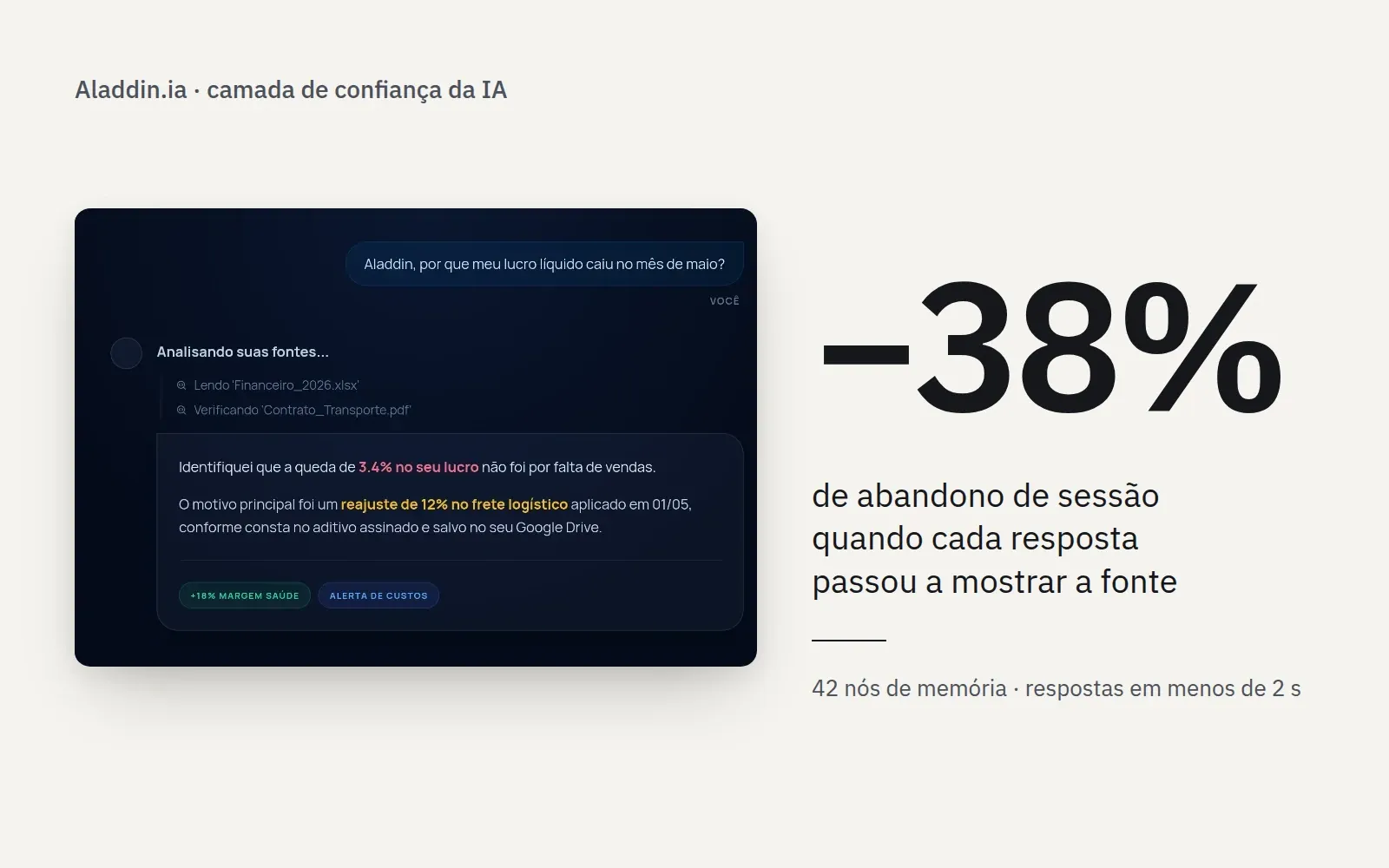
Charts use numbers that can be traced to the source
When the revenue chart used values absent from the PDF, I set a source rule. Every point in the chart had to refer to a number in the document. Points without a source number were omitted.
The AI's memory is visible.
I organized the knowledge base into active memory nodes. Users saw what the AI knew about the business and could inspect what it used to answer.
Accuracy is measured on every release.
I built a reference set of cases. The release was blocked if accuracy dropped, if latency rose, or if data leaked between customers.
Revenue projection is deterministic.
Same input, same output. Values outside the expected pattern became an anomaly alert.
Any automation comes in through one link, and an active watcher reads what arrives.
ClickTap the numbers
One link for any automation
Decision 1 of 4
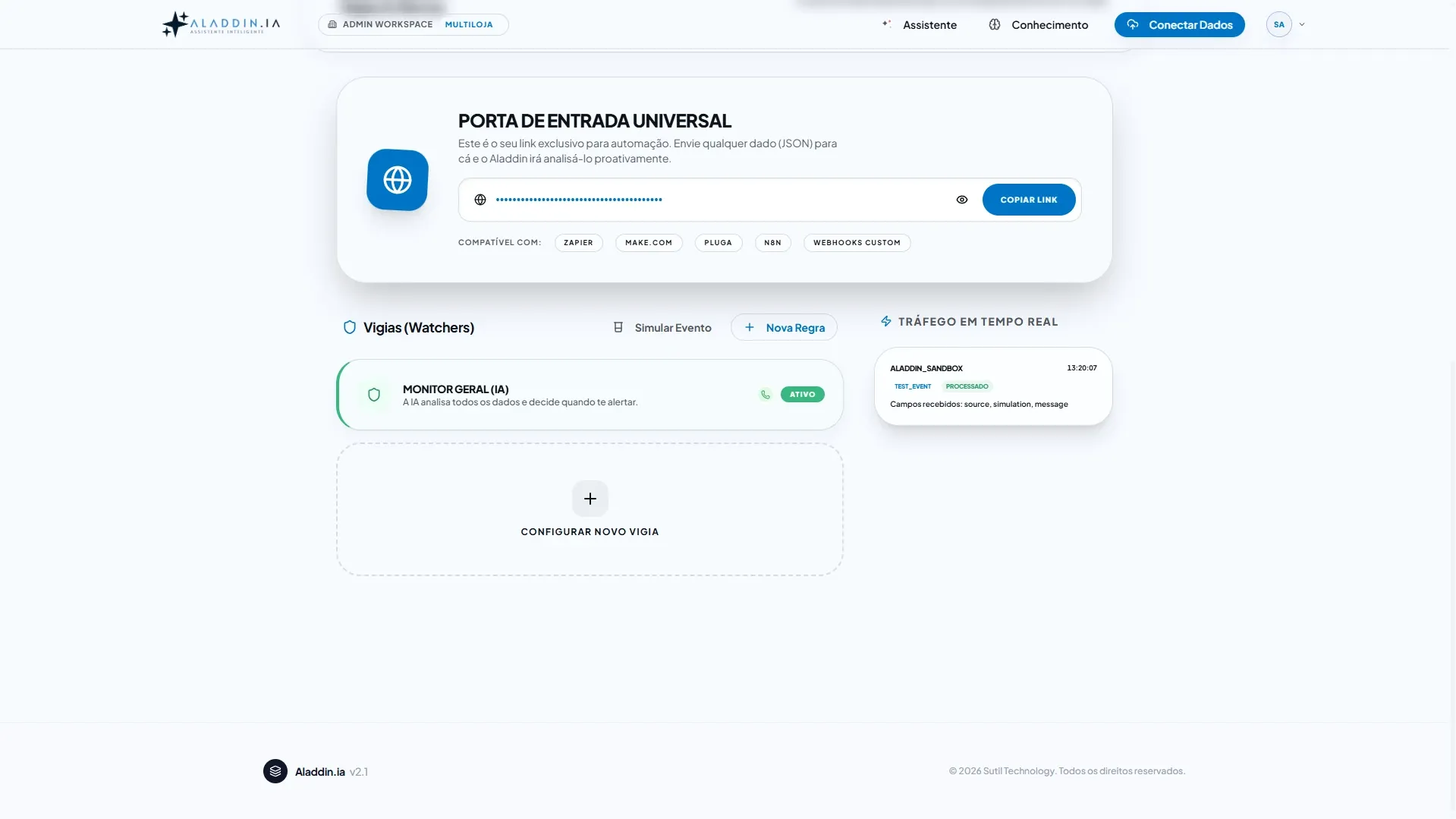
A unique link accepted any JSON. Zapier, Make, Pluga, n8n or your own webhook: Aladdin read what arrived and analyzed it on its own.
One link for any automation
A unique link accepted any JSON. Zapier, Make, Pluga, n8n or your own webhook: Aladdin read what arrived and analyzed it on its own.
Masked link
The address was masked. Revealing it was an explicit action, and copying didn't require showing it.
Default watcher already active
The default watcher was on from the start: it read everything that came in and decided when something was worth an alert. Custom rules came later.
Real-time events
Each event showed up instantly, with its status and the fields received. You could test it with “Simulate event” before connecting the real tool.
Credentials live in a vault.
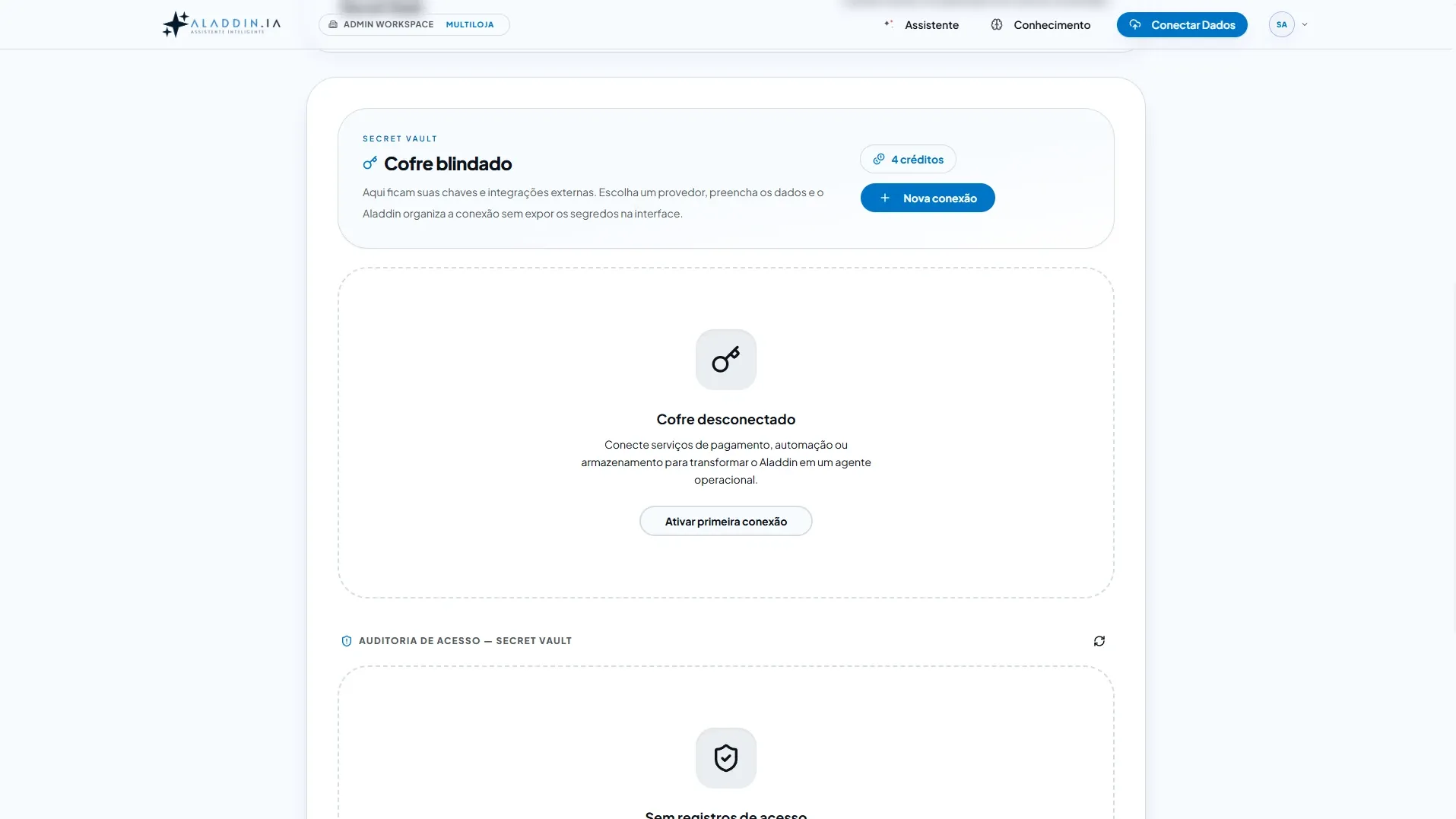
Keys and integrations lived in a vault. The interface managed the connection without showing the secret, and every access was recorded in an audit log.
What changed
The capture documents how the interface showed files read and the source of an answer. The drop in session abandonment comes from a reported comparison between versions. The sample, period and baseline are outside the public record, so the effect of the change on its own remains open.
- −38%
session abandonment after the trust layer
Evidence: Reported - < 2 s
for the AI to respond
Evidence: Reported - Accuracy
reference set of cases measured on every release: if accuracy dropped, the release didn't ship
Evidence: Deliverable
Sources and limits
Session abandonment compared before and after the trust layer, which began showing the files read and the source of each number.
Aladdin.ia has no public version to visit: the images are captures of the version presented in this case study.
Baseline, period and sample for the −38% are not published, so the number cannot be re-verified. Response time is also a report.
How to read the level of evidence
- Evidence: Deliverable
- Something that exists and was delivered. It describes the work, not an outcome.
- Evidence: Reported
- Stated by me or by stakeholders, with no published data.
Appendix: process
Process
- The invented chart
- The AI read a PDF and drew a revenue chart with numbers that weren't in the document.
- Plot by reference
- The chart only plots by reference: every value has to point to a number in the document.
- Visible source
- Every answer began showing the files read and the source cited. Session abandonment dropped 38% (reported).
- Reference set
- A reference set of cases measured accuracy, and the release was blocked if accuracy dropped, latency rose or data leaked.
Updated .
Hiring a Senior Product Designer or DesignOps Lead?
I am available immediately, 100% remote. Let's talk about how I can help your product.